Starters
Cucumber som tam – weighed version
Cucumber som tam – weighed version.
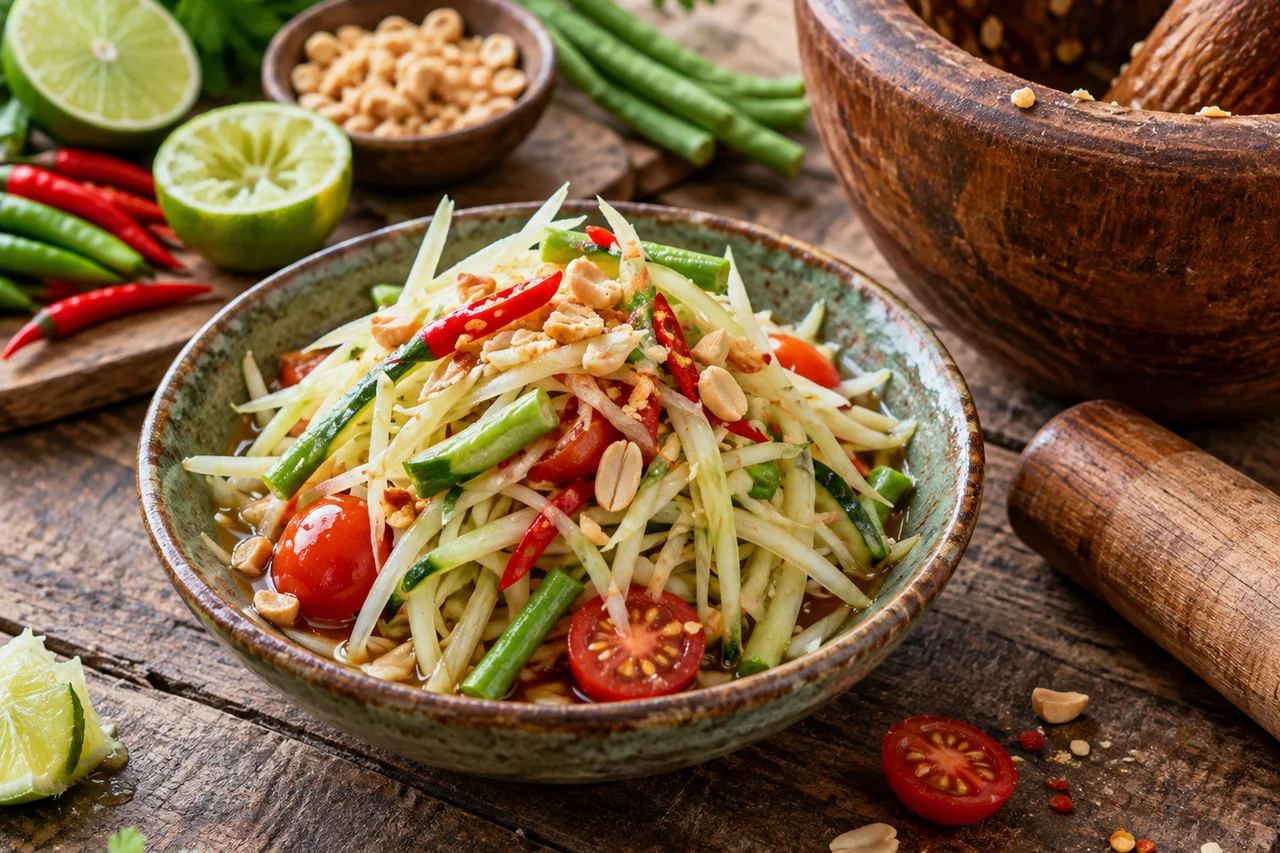
Servings in this printout: 4
Ingredients
- 500 g edible cucumber after removing the seed core
- 150 g tomato
- 100 g cooked drained green beans
- 30 g whole unsalted roasted peanuts
- 3.5 g peeled fresh garlic
- 5 g fresh chilli
- 30 g lime juice
- 15 g fish sauce, generic AFCD composition proxy
- 4 g Foodin erythritol
- salt to taste
Method
- Weigh all listed edible ingredients. Do not add unlisted oil or side dishes.
- Remove the cucumber seed core, then weigh 500 g edible cucumber. Weigh 100 g already cooked and drained green beans; do not use raw beans. Cut the tomato.
- Crush the garlic and chilli. Coarsely chop half the whole roasted peanuts; do not grind them into a paste. Add lime juice, fish sauce and 4 g Foodin erythritol.
- Combine all vegetables and dressing, then add the remaining peanuts. Consume all dressing and divide into four portions.
Nutrition per serving
Nutrition values are approximate estimates, not laboratory analyses. Products and portion size affect the result.
- Net carbs
- 5.33 g
- Total carbohydrates (incl. fibre and polyols)
- 9.7 g
- Protein
- 3.78 g
- Fat
- 4.24 g
- Modeled GL estimate
- about 2 / serving
low GL
Confidence · Low Some values or assumptions in the calculation are uncertain.
The estimate combines ingredient carbohydrate and GI data with modeled assumptions. The calculation also uses comparison values from similar foods or food groups.
Estimate details and sources ↗
How was the estimate calculated?
The serving’s GL is calculated from ingredient data. Confidence describes the evidence behind the calculation. Your blood sugar response may vary.
- Value used in the model
- Comparison value
All available carbohydrate is included, with no small portions omitted. This is a modeled ingredient estimate, not a measured meal response. Biological uncertainty has not been quantified.
Research sources and technical details
Source names and technical notes appear in their original form.
Carbohydrate data sources
- KURKKU · THL Fineli Release20 CC BY4.0
- TOMAATTI · THL Fineli Release20 CC BY4.0
- Bean, green, fresh, boiled, drained · FSANZ AFCD Release3 CC BY-SA3.0 Australia
- Nut, peanut, without skin, roasted, with oil, unsalted · FSANZ AFCD Release3 CC BY-SA3.0 Australia
- Garlic, peeled, fresh, raw · FSANZ AFCD Release3 CC BY-SA3.0 Australia
- Chilli (chili), green, raw · FSANZ AFCD Release3 CC BY-SA3.0 Australia
- Juice, lime · FSANZ AFCD Release3 CC BY-SA3.0 Australia
- Sauce, fish, commercial · FSANZ AFCD Release3 CC BY-SA3.0 Australia
- Foodin Erytritoli, Luomu 200 g · Foodin product-label factual nutrient declaration; product reference only, not an open-database licence
GI and calculation sources
- Published assignment for low-carbohydrate vegetables, not measured food GI · GK80 PUBLISHED_IMPUTATION: Coding estimate only. Application to named fresh herbs, sprouts and alliums is an explicit project interpretation. It does not establish a physiological maximum or a one-unit uncertainty bound. Not a default for seed spices, flour, sauces or stock.. Recipe-specific applicability: Named weighed edible input; all listed portions consumed; raw-input nutrient retention proxy, not measured cooked-food retention. Explicit NONSTARCHY_VEGETABLE identity. Published GI coding plus project scope, not human-measured ingredient GI.; Named weighed edible input; all listed portions consumed; raw-input nutrient retention proxy, not measured cooked-food retention. Explicit NONSTARCHY_VEGETABLE identity. Published GI coding plus project scope, not human-measured ingredient GI.; Named weighed edible input; all listed portions consumed; raw-input nutrient retention proxy, not measured cooked-food retention. Explicit NONSTARCHY_VEGETABLE identity. Published GI coding plus project scope, not human-measured ingredient GI.; Named weighed edible input; all listed portions consumed; raw-input nutrient retention proxy, not measured cooked-food retention. Explicit NONSTARCHY_VEGETABLE identity. Published GI coding plus project scope, not human-measured ingredient GI.; Named weighed edible input; all listed portions consumed; raw-input nutrient retention proxy, not measured cooked-food retention. Explicit NONSTARCHY_VEGETABLE identity. Published GI coding plus project scope, not human-measured ingredient GI. (Low)CALCULATION_POLICY · PUBLISHED_IMPUTATION · PUBLISHED_IMPUTATION
- Whole peanuts, preparation unspecified; explicit analogy to roasted peanuts · GK80 HUMAN_GI: Small sample; preparation/roast unspecified; LOW applied whole-food analogy, not direct recipe GI. SEM6 is not a biological recipe range. No second glucose conversion.. Recipe-specific applicability: Named weighed edible input; all listed portions consumed; raw-input nutrient retention proxy, not measured cooked-food retention. Explicit WHOLE_PEANUT identity. Human food comparator used as LOW applied analogy; food/preparation limitations preserved. (Low)ANALOG · HUMAN_GI · FOOD_ANALOGUE
- Named foods with <=5 g available CHO/100 g · GK80 PUBLISHED_IMPUTATION: Published low-carbohydrate default50, applied only to reviewed named compositions <=5 g available CHO/100g. This cutoff is a project rule, not a validated scientific threshold. Explicit AFCD commercial soy sauce and AFCD tahini plus complete Maille Dijon label are allowed, not all brands or pastes. No flour/sugar/honey/syrup or composition-unknown food.. Recipe-specific applicability: Named weighed edible input; all listed portions consumed; raw-input nutrient retention proxy, not measured cooked-food retention. Explicit CITRUS_JUICE identity. Published GI coding plus project scope, not human-measured ingredient GI.; Named weighed edible input; all listed portions consumed; raw-input nutrient retention proxy, not measured cooked-food retention. Explicit FISH_SAUCE identity. Published GI coding plus project scope, not human-measured ingredient GI. (Low)CALCULATION_POLICY · PUBLISHED_IMPUTATION · PUBLISHED_IMPUTATION
Keto and low-carb labels are editorial classifications. They have not been verified through nutrition calculations for every recipe.
Notes
The GL is a modeled ingredient-sum estimate with low confidence, not a measured meal response. All available carbohydrate is included; no biological uncertainty interval is known. The photograph illustrates serving only; unlisted side dishes are excluded from the nutrition and GL estimates.
Use whole roasted peanuts, coarsely chopped, not peanut butter or flour. The fish sauce uses generic AFCD composition, not a verified brand label. Erythritol is counted once in total carbohydrate and adds no net carbohydrate.