Main courses
Low-carb pad kee mao with chicken and konjac noodles
Prepare the ingredients before frying: food cooks quickly in a wok. Dry fry the noodles first so that the sauce sticks to them.
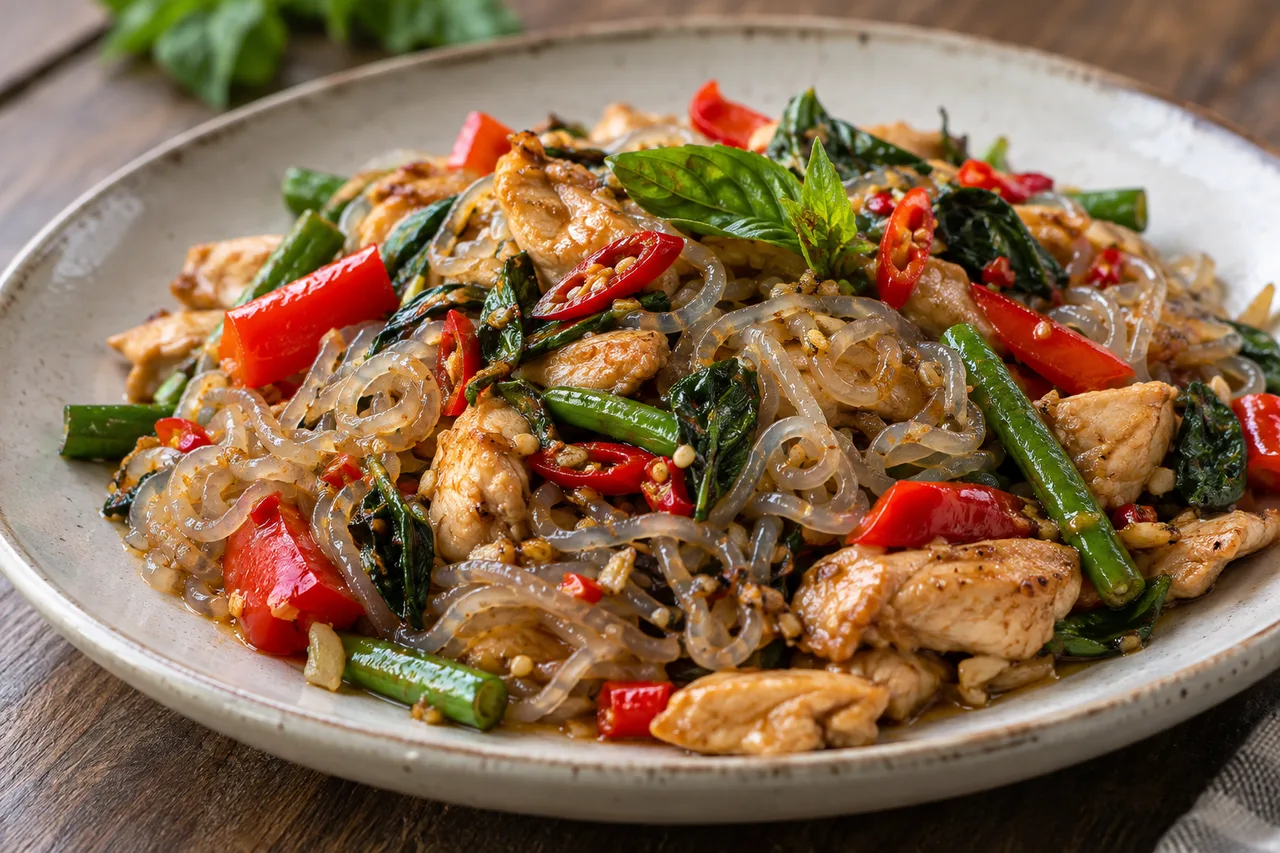
Servings in this printout: 4
Ingredients
- 600 g KoRo prepared konjac noodles
- 500 g skinless chicken thigh meatin strips
- 150 g green beanshalved
- 120 g red pepperin strips
- 30 g Thai basil leaves
- 10.5 g a clove of garliccrushed
- 24 g red chilisliced; adjust the heat to taste
- 30 g Squid Brand fish sauce
- 15 g soy sauce
- 15 g commercial oyster sauce
- 4 g Foodin erythritol
- 27 g neutral oil
Method
- Boil fresh green beans for 5–7 minutes until cooked and drain. For frozen beans, follow the packet cooking instructions. Rinse and drain the noodles. Dry-fry them in a hot pan for 3–4 minutes and set aside.
- Mix fish sauce, soy sauce, oyster sauce and erythritol.
- Heat the oil in a wok. Fry the chicken until cooked and set it aside for a while.
- Add garlic and chili to the pan. Fry for about 30 seconds, add the beans and paprika and fry for a few minutes.
- Add the noodles, chicken and sauce. Turn on the hot pan until everything is hot.
- Remove the pan from the stove and stir in the Thai basil. Offer now.
Original recipe nutrition per serving
The nutrition values below belong to the original recipe. They are not nutrition values for the separate GL-only version. No macro package has been verified for the GL-only version.
Nutrition values are approximate estimates, not laboratory analyses. Products and portion size affect the result.
- Net carbs
- 4.53 g
- Total carbohydrates (incl. fibre and polyols)
- 12.09 g
- Protein
- 26.37 g
- Fat
- 10.81 g
A reliable glycemic load estimate is not available.
Some ingredient data or calculation inputs could not be verified, so there is no reliable estimate for the whole serving.
Why is the estimate missing?
- red pepper · A suitable GI value was unavailable for this ingredient.
Keto and low-carb labels are editorial classifications. They have not been verified through nutrition calculations for every recipe.
Estimate for the modified recipe
Original recipe GL unavailable
Calculated GL · ≈ 1.8 / serving
Confidence · Low Some values or assumptions in the calculation are uncertain.
The estimate uses the ingredients and amounts in this version and the available source data. Small amounts of carbohydrate were left out of the calculation.
How was the estimate calculated?
This estimate applies only to the amounts and preparation details below. The original recipe nutrition is not a macro package for this version.
GI-unmatched available carbohydrate omitted, up to 1 g/serving. Its effect is not assumed to be zero.
Confidence: low. An ingredient-based estimate, not a measurement of the prepared meal.
Value used in the model
Original recipe amounts and preparation
- 600 g · KoRo prepared konjac noodles
- 500 g · skinless chicken thigh meat
- 150 g · green beans
- 120 g · red pepper
- 30 g · Thai basil leaves
- 10.5 g · a clove of garlic
- 24 g · red chili
- 30 g · Squid Brand fish sauce
- 15 g · soy sauce
- 15 g · commercial oyster sauce
- 4 g · Foodin erythritol
- 27 g · neutral oil
Boil fresh green beans for 5–7 minutes until cooked and drain. For frozen beans, follow the packet cooking instructions. Rinse and drain the noodles. Dry-fry them in a hot pan for 3–4 minutes and set aside. Mix fish sauce, soy sauce, oyster sauce and erythritol. Heat the oil in a wok. Fry the chicken until cooked and set it aside for a while. Add garlic and chili to the pan. Fry for about 30 seconds, add the beans and paprika and fry for a few minutes. Add the noodles, chicken and sauce. Turn on the hot pan until everything is hot. Remove the pan from the stove and stir in the Thai basil. Offer now.
Separate version amounts and preparation
Servings for these amounts · 4
- 600 g · KoRo konjac fettuccine in water, drained
- 500 g · skinless chicken thigh
- 150 g · fresh green beans
- 120 g · red sweet pepper
- 30 g · Thai basil
- 10.5 g · fresh garlic
- 24 g · red chilli
- 30 g · Squid Brand fish sauce
- 15 g · ordinary soy sauce, not dark sweet sauce
- 15 g · commercial oyster sauce
- 4 g · Foodin erythritol (100%)
- 27 g · neutral cooking oil
Use the original method with these details.
Weigh the ready-in-water KoRo fettuccine after draining. Precook beans5–7min and dry-fry the drained noodles3–4min by the original method. Retain all listed sauces, ordinary non-sweet soy sauce and Thai basil. Dried konjac is outside this version.
Research sources and technical details
Source names and technical notes appear in their original form.
Sources and limitations · A
Assumption sensitivity
1.796–3.203 / serving
This experiment assigns GI assumptions0–150 to selected uncertain portions. It is neither a physiological upper bound nor a statistical confidence interval.
- Conclusions: assignment discussion · Project published-imputation assignment, not measured ingredient or meal GI. Coding estimate only. Application to named fresh herbs, sprouts and alliums is an explicit project interpretation. It does not establish a physiological maximum or a one-unit uncertainty bound. Not a default for seed spices, flour, sauces or stock.PUBLISHED_CODING
- Author presentation slide 12 · Project published-imputation assignment, not measured ingredient or meal GI. Published low-carbohydrate default. The <=5 g/100 g operational cutoff and named bindings are explicit project interpretation, not a threshold validated by Schakel. Excludes ordinary fruit, flour, concentrated sauce and nuts above the cutoff.PUBLISHED_CODING
- KoRo ready-in-water fettuccine; nominal declared totalCHO ceiling · Nominal manufacturer source-model carbohydrate upper only; not zero or an analytical/lot-variability bound. Unknown polyols retained.BOUND
- BROILERI, KOIPI-REISI, NAHATON · THL Fineli Release20 available carbohydrate; CC BY4.0. Total polyols not inferred.CARBOHYDRATE
- PAPU, VIHREÄ TAITEPAPU, TUORE · THL Fineli Release20 available carbohydrate; CC BY4.0. Total polyols not inferred.CARBOHYDRATE
- PAPRIKA, PUNAINEN · THL Fineli Release20 available carbohydrate; CC BY4.0. Total polyols not inferred.CARBOHYDRATE
- BASILIKA, TUORE · THL Fineli Release20 available carbohydrate; CC BY4.0. Total polyols not inferred.CARBOHYDRATE
- VALKOSIPULI · THL Fineli Release20 available carbohydrate; CC BY4.0. Total polyols not inferred.CARBOHYDRATE
- Chilli (chili), red, raw · FSANZ AFCD Release3 available carbohydrate WITHOUT sugar alcohols; Australian composition proxy; CC BY-SA3.0 Australia. Total polyols not inferred.CARBOHYDRATE
- Sauce, fish, commercial · FSANZ AFCD Release3 available carbohydrate WITHOUT sugar alcohols; Australian composition proxy; CC BY-SA3.0 Australia. Total polyols not inferred.CARBOHYDRATE
- Sauce, soy, commercial · FSANZ AFCD Release3 available carbohydrate WITHOUT sugar alcohols; Australian composition proxy; CC BY-SA3.0 Australia. Total polyols not inferred.CARBOHYDRATE
- Sauce, oyster, commercial · FSANZ AFCD Release3 available carbohydrate WITHOUT sugar alcohols; Australian composition proxy; CC BY-SA3.0 Australia. Total polyols not inferred.CARBOHYDRATE
- Foodin 100% erythritol · Foodin label: carbohydrate100 minus explicitly declared polyols100CARBOHYDRATE
- RUOKAÖLJY KESKIARVO, 87 % RYPSI- 8 % AURINGONKUKKA- JA 5% OLIIVIÖLJY · THL Fineli Release20 available carbohydrate; CC BY4.0. Total polyols not inferred.CARBOHYDRATE
Notes
- konjac noodles replace rice noodles. The amount of carbohydrates in sauces varies by brand.
- Nutrition values are approximate estimates and depend on the products and portion size used.