Main courses
Butter chicken – weighed honey version
Butter chicken – weighed honey version.
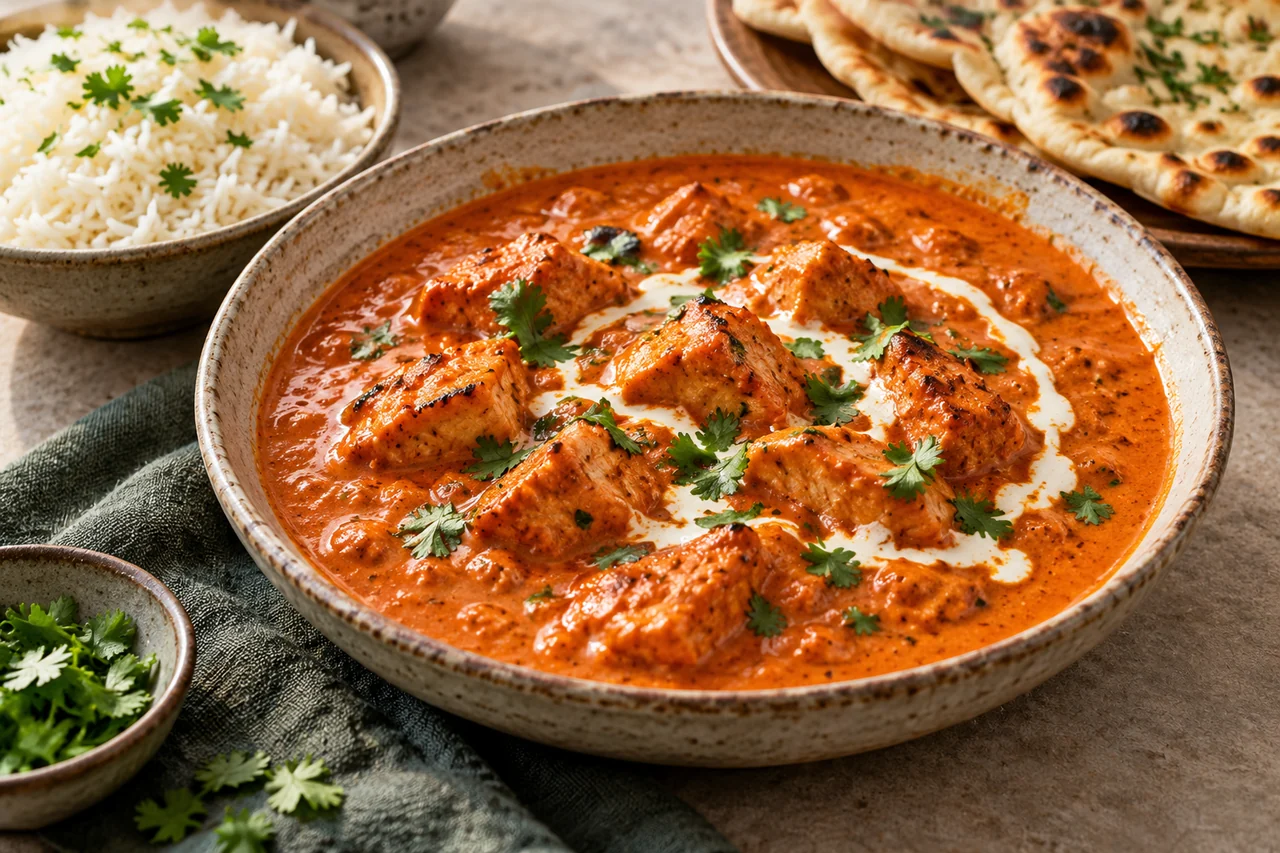
Servings in this printout: 4
Ingredients
- 700 g raw skinless boneless chicken thigh meat
- 150 g plain lactose-free Greek yogurt, 7% fat
- 15 g lemon juice
- 1.5 g ground coriander
- 1 g ground cumin
- 0.6 g ground cinnamon
- 0.4 g ground cardamom
- 0.2 g ground cloves
- 0.3 g ground black pepper
- 2 g ground cumin
- 30 g butter
- 55 g onion
- 7 g peeled fresh garlic
- 20 g fresh peeled ginger
- 400 g crushed tomatoes
- 200 g whipping cream, 38% fat
- 2 g paprika powder
- 21 g honey
- 10 g fresh coriander
- 13.5 g olive oil
- salt to taste
Method
- Weigh all listed edible ingredients. Do not add unlisted oil or side dishes.
- Mix the six garam masala spices (4 g in total), the additional 2 g cumin, yogurt and lemon juice. Marinate 700 g skinless edible chicken thigh meat for 20 min.
- Brown the chicken in the olive oil, retaining all marinade. Soften the onion in the butter, then add garlic, ginger and paprika. Add the crushed tomatoes and simmer for 10 min.
- Add cream, 21 g honey, chicken and all marinade. Cook the chicken throughout to at least 75 °C. Finish with coriander and divide all meat and sauce into four portions. Side dishes are excluded.
- Cook every part that contains raw animal ingredients thoroughly. Consume all ingredients and pan juices. Raw ingredient composition is a nutrient-retention proxy; unmeasured losses are not deducted.
Nutrition per serving
Nutrition values are approximate estimates, not laboratory analyses. Products and portion size affect the result.
- Net carbs
- 11.54 g
- Total carbohydrates (incl. fibre and polyols)
- 13.17 g
- Protein
- 38.73 g
- Fat
- 36.96 g
- Modeled GL estimate
- about 5 / serving
low GL
Confidence · Low Some values or assumptions in the calculation are uncertain.
The estimate combines ingredient carbohydrate and GI data with modeled assumptions. The calculation also uses comparison values from similar foods or food groups.
Estimate details and sources ↗
How was the estimate calculated?
The serving’s GL is calculated from ingredient data. Confidence describes the evidence behind the calculation. Your blood sugar response may vary.
- Food group average
- Value used in the model
- Comparison value
All available carbohydrate is included, with no small portions omitted. This is a modeled ingredient estimate, not a measured meal response. Biological uncertainty has not been quantified.
Research sources and technical details
Source names and technical notes appear in their original form.
Carbohydrate data sources
- Chicken, thigh, lean flesh, raw · FSANZ AFCD Release3 CC BY-SA3.0 Australia
- JOGURTTI, MAUSTAMATON, KREIKKALAINEN, RASVAA 7 %, LAKTOOSITON · THL Fineli Release20 CC BY4.0
- TÄYSMEHU, SITRUUNATÄYSMEHU, LAIMENTAMATON · THL Fineli Release20 CC BY4.0
- Coriander seed, dried, ground · FSANZ AFCD Release3 CC BY-SA3.0 Australia
- Cumin (cummin) seed, dried, ground · FSANZ AFCD Release3 CC BY-SA3.0 Australia
- Cinnamon, dried, ground · FSANZ AFCD Release3 CC BY-SA3.0 Australia
- Cardamom seed, dried, ground · FSANZ AFCD Release3 CC BY-SA3.0 Australia
- Cloves, dried, ground · FSANZ AFCD Release3 CC BY-SA3.0 Australia
- Pepper, black, ground · FSANZ AFCD Release3 CC BY-SA3.0 Australia
- VOI · THL Fineli Release20 CC BY4.0
- SIPULI, KELTASIPULI · THL Fineli Release20 CC BY4.0
- Garlic, peeled, fresh, raw · FSANZ AFCD Release3 CC BY-SA3.0 Australia
- Ginger, peeled, fresh, raw · FSANZ AFCD Release3 CC BY-SA3.0 Australia
- TOMAATTIMURSKA · THL Fineli Release20 CC BY4.0
- KERMA, KUOHUKERMA, RASVAA 38 % · THL Fineli Release20 CC BY4.0
- Paprika, dry powder · FSANZ AFCD Release3 CC BY-SA3.0 Australia
- Honey · FSANZ AFCD Release3 CC BY-SA3.0 Australia
- Coriander, fresh, raw · FSANZ AFCD Release3 CC BY-SA3.0 Australia
- OLIIVIÖLJY · THL Fineli Release20 CC BY4.0
GI and calculation sources
- International table of glycemic index and glycemic load values: 2002 · Honey GI varies widely by floral source and fructose content. The 55 mean is an approximate category value, not a measured GI for the recipe's honey. (Low)CATEGORY_MEAN
- Unsweetened animal dairy coding assignment · GK80 PUBLISHED_IMPUTATION: Not tested cream, cheese or butter. Excludes plant drinks and sweetened dairy.. Recipe-specific applicability: Named weighed edible input; all listed portions consumed; raw-input nutrient retention proxy, not measured cooked-food retention. Explicit YOGURT identity. Published GI coding plus project scope, not human-measured ingredient GI.; Named weighed edible input; all listed portions consumed; raw-input nutrient retention proxy, not measured cooked-food retention. Explicit DAIRY identity. Published GI coding plus project scope, not human-measured ingredient GI.; Named weighed edible input; all listed portions consumed; raw-input nutrient retention proxy, not measured cooked-food retention. Explicit DAIRY identity. Published GI coding plus project scope, not human-measured ingredient GI. (Low)CALCULATION_POLICY · PUBLISHED_IMPUTATION · PUBLISHED_IMPUTATION
- Named foods with <=5 g available CHO/100 g · GK80 PUBLISHED_IMPUTATION: Published low-carbohydrate default50, applied only to reviewed named compositions <=5 g available CHO/100g. This cutoff is a project rule, not a validated scientific threshold. Explicit AFCD commercial soy sauce and AFCD tahini plus complete Maille Dijon label are allowed, not all brands or pastes. No flour/sugar/honey/syrup or composition-unknown food.. Recipe-specific applicability: Named weighed edible input; all listed portions consumed; raw-input nutrient retention proxy, not measured cooked-food retention. Explicit CITRUS_JUICE identity. Published GI coding plus project scope, not human-measured ingredient GI. (Low)CALCULATION_POLICY · PUBLISHED_IMPUTATION · PUBLISHED_IMPUTATION
- Fixed weighed culinary ground spice, seed or vanilla extract · GK80 PUBLISHED_IMPUTATION: Own project extension of coding default, not measured food GI or directly published Schakel scope. Full composition and consumed grams mandatory; <=0.5 g CHO each and <=1 g aggregate per serving. Includes named vanilla extract, dried herbs and whole seed garnish. Excludes flour, baking powder, bulk paste, sugar, unknown extraction and sticks/pods. No biological error bound. USDA total-carbohydrate minus fibre is a disclosed available-CHO proxy; endogenous polyols unquantified, not asserted zero. This additional proxy use awaits owner method approval.. Recipe-specific applicability: Named weighed edible input; all listed portions consumed; raw-input nutrient retention proxy, not measured cooked-food retention. Explicit GROUND_SPICE identity. Published GI coding plus project scope, not human-measured ingredient GI.; Named weighed edible input; all listed portions consumed; raw-input nutrient retention proxy, not measured cooked-food retention. Explicit GROUND_SPICE identity. Published GI coding plus project scope, not human-measured ingredient GI.; Named weighed edible input; all listed portions consumed; raw-input nutrient retention proxy, not measured cooked-food retention. Explicit GROUND_SPICE identity. Published GI coding plus project scope, not human-measured ingredient GI.; Named weighed edible input; all listed portions consumed; raw-input nutrient retention proxy, not measured cooked-food retention. Explicit GROUND_SPICE identity. Published GI coding plus project scope, not human-measured ingredient GI.; Named weighed edible input; all listed portions consumed; raw-input nutrient retention proxy, not measured cooked-food retention. Explicit GROUND_SPICE identity. Published GI coding plus project scope, not human-measured ingredient GI.; Named weighed edible input; all listed portions consumed; raw-input nutrient retention proxy, not measured cooked-food retention. Explicit GROUND_SPICE identity. Published GI coding plus project scope, not human-measured ingredient GI.; Named weighed edible input; all listed portions consumed; raw-input nutrient retention proxy, not measured cooked-food retention. Explicit GROUND_SPICE identity. Published GI coding plus project scope, not human-measured ingredient GI.; Named weighed edible input; all listed portions consumed; raw-input nutrient retention proxy, not measured cooked-food retention. Explicit GROUND_SPICE identity. Published GI coding plus project scope, not human-measured ingredient GI. (Low)CALCULATION_POLICY · PUBLISHED_IMPUTATION · PUBLISHED_IMPUTATION
- Published assignment for low-carbohydrate vegetables, not measured food GI · GK80 PUBLISHED_IMPUTATION: Coding estimate only. Application to named fresh herbs, sprouts and alliums is an explicit project interpretation. It does not establish a physiological maximum or a one-unit uncertainty bound. Not a default for seed spices, flour, sauces or stock.. Recipe-specific applicability: Named weighed edible input; all listed portions consumed; raw-input nutrient retention proxy, not measured cooked-food retention. Explicit NONSTARCHY_VEGETABLE identity. Published GI coding plus project scope, not human-measured ingredient GI.; Named weighed edible input; all listed portions consumed; raw-input nutrient retention proxy, not measured cooked-food retention. Explicit NONSTARCHY_VEGETABLE identity. Published GI coding plus project scope, not human-measured ingredient GI.; Named weighed edible input; all listed portions consumed; raw-input nutrient retention proxy, not measured cooked-food retention. Explicit NONSTARCHY_VEGETABLE identity. Published GI coding plus project scope, not human-measured ingredient GI.; Named weighed edible input; all listed portions consumed; raw-input nutrient retention proxy, not measured cooked-food retention. Explicit NONSTARCHY_VEGETABLE identity. Published GI coding plus project scope, not human-measured ingredient GI.; Named weighed edible input; all listed portions consumed; raw-input nutrient retention proxy, not measured cooked-food retention. Explicit NONSTARCHY_VEGETABLE identity. Published GI coding plus project scope, not human-measured ingredient GI. (Low)CALCULATION_POLICY · PUBLISHED_IMPUTATION · PUBLISHED_IMPUTATION
- Honey, mean of 11 types · GK80 HUMAN_GI: Honey GI varies widely by floral source and fructose content. The 55 mean is an approximate category value, not a measured GI for the recipe's honey.. Recipe-specific applicability: Named weighed edible input; all listed portions consumed; raw-input nutrient retention proxy, not measured cooked-food retention. Explicit HONEY identity. Human food comparator used as LOW applied analogy; food/preparation limitations preserved. (Low)ANALOG · HUMAN_GI · FOOD_ANALOGUE
Notes
The GL is a modeled ingredient-sum estimate with low confidence, not a measured meal response. All available carbohydrate is included; no biological uncertainty interval is known. The photograph illustrates serving only; unlisted side dishes are excluded from the nutrition and GL estimates.
This version includes all 21 g honey and all marinade. Prepare the six listed garam masala spices separately from the additional 2 g cumin. Rice and naan are excluded.