Main courses
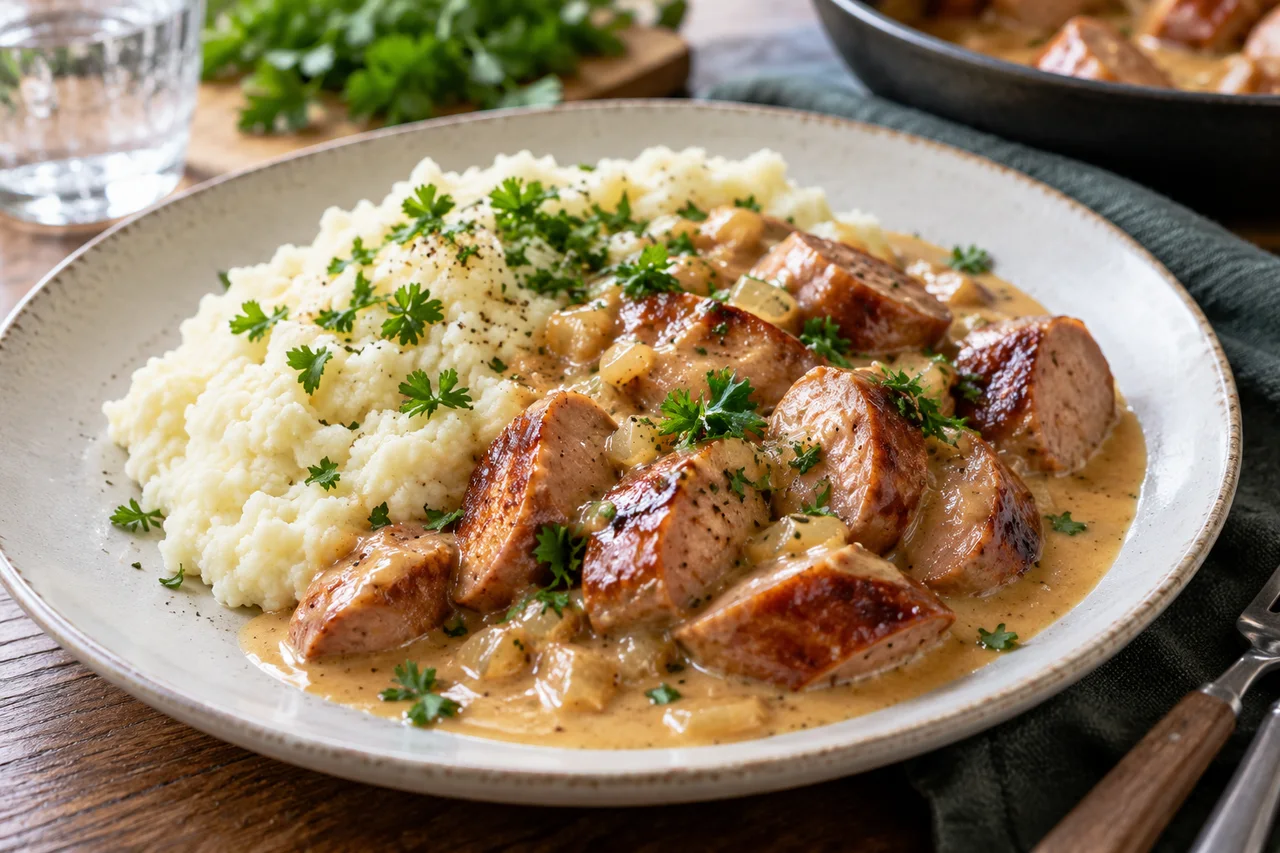
Sausage Sauce with Cauliflower Mash
The familiar everyday food is suitable for a low-carbohydrate diet when the sauce is thickened by boiling and cauliflower is chosen as an addition. Check the amount of carbohydrates in the sausage on the product packaging.
Servings in this printout: 4
Ingredients
- 400 g cooked frankfurter sausages
- 30 g peeled onion
- 200 g whipping cream, 38% fat
- 100 g ready-to-use diluted beef stock
- 5 g French's Dijon Mustard, US 32 oz product
- 1.15 g black pepper
- 600 g cauliflower
- 40 g butter
- saltto taste
Method
- Slice the frankfurter sausages and finely chop the onion. Brown the sausages in a frying pan, then add the onion and soften it.
- Pour the meat broth and whipping cream into the pan. Mix in the mustard and black pepper. Simmer gently for 8-10 minutes until the sauce thickens a bit. Taste before adding salt.
- Chop the cauliflower and cook in salted water until soft. Drain carefully and allow excess steam to evaporate.
- Puree the cauliflower with butter. Season with salt and serve with sausage sauce.
Nutrition per serving
Nutrition values are approximate estimates, not laboratory analyses. Products and portion size affect the result.
- Net carbs
- 7.33 g
- Total carbohydrates (incl. fibre and polyols)
- 10.28 g
- Protein
- 15.55 g
- Fat
- 45.83 g
- Modeled GL estimate
- about 3 / serving
low GL
Confidence · Low Some values or assumptions in the calculation are uncertain.
The estimate combines ingredient carbohydrate and GI data with modeled assumptions. Small amounts of carbohydrate were left out of the calculation.
Estimate details and sources ↗
How was the estimate calculated?
The serving’s GL is calculated from ingredient data. Confidence describes the evidence behind the calculation. Your blood sugar response may vary.
- cooked frankfurter sausages · Value used in the model
- peeled onion · Value used in the model
- whipping cream, 38% fat · Value used in the model
- ready-to-use diluted beef stock · Value used in the model
- cauliflower · Value used in the model
- butter · Value used in the model
Documented small portions are omitted from this calculation. Their combined amount or documented upper bound is shown separately. This is a modeled ingredient estimate, not a measured meal response. Biological uncertainty has not been quantified.
Small portions omitted: 0.3 g available carbohydrate per serving.
Research sources and technical details
Source names and technical notes appear in their original form.
- cooked frankfurter sausages ·
op142-lowcho50-v2 · op146-fineli-7600 - peeled onion ·
op142-vegetable-imputation40 · op146-fineli-335 - whipping cream, 38% fat ·
op142-dairy-imputation30 · op146-fineli-631 - ready-to-use diluted beef stock ·
op142-lowcho50-v2 · op146-fineli-29 - cauliflower ·
op142-vegetable-imputation40 · op146-fineli-322 - butter ·
op142-dairy-imputation30 · op146-fineli-500
Carbohydrate data sources
- NAKKI, KEITETTY · Available-carbohydrate value from THL Fineli Rel20; CC BY 4.0.
- SIPULI, KELTASIPULI · Available-carbohydrate value from THL Fineli Rel20; CC BY 4.0.
- KERMA, KUOHUKERMA, RASVAA 38 % · Available-carbohydrate value from THL Fineli Rel20; CC BY 4.0.
- LIHALIEMI, LAIMENNETTU · Available-carbohydrate value from THL Fineli Rel20; CC BY 4.0.
- KUKKAKAALI · Available-carbohydrate value from THL Fineli Rel20; CC BY 4.0.
- VOI · Available-carbohydrate value from THL Fineli Rel20; CC BY 4.0.
GI and calculation sources
- PROJECT PI, not measured food GI: Named foods with <=5 g available CHO/100 g · Project published-imputation assignment, not measured ingredient or meal GI. Published low-carbohydrate default. The <=5 g/100 g operational cutoff and named bindings are explicit project interpretation, not a threshold validated by Schakel. Excludes ordinary fruit, flour, concentrated sauce and nuts above the cutoff. (Low)CALCULATION_POLICY · PUBLISHED_IMPUTATION · PUBLISHED_IMPUTATION
- PROJECT PI, not measured food GI: Published assignment for low-carbohydrate vegetables, not measured food GI · Project published-imputation assignment, not measured ingredient or meal GI. Coding estimate only. Application to named fresh herbs, sprouts and alliums is an explicit project interpretation. It does not establish a physiological maximum or a one-unit uncertainty bound. Not a default for seed spices, flour, sauces or stock. (Low)CALCULATION_POLICY · PUBLISHED_IMPUTATION · PUBLISHED_IMPUTATION
- PROJECT PI, not measured food GI: Unsweetened animal dairy coding assignment · Project published-imputation assignment, not measured ingredient or meal GI. Not tested cream, cheese or butter. Excludes plant drinks and sweetened dairy. (Low)CALCULATION_POLICY · PUBLISHED_IMPUTATION · PUBLISHED_IMPUTATION
Keto and low-carb labels are editorial classifications. They have not been verified through nutrition calculations for every recipe.
Notes
- Choose as low-carb frankfurter sausages as possible and check the ingredient list.
- If you want the sauce to be thicker, let it boil a little longer. Do not use wheat flour.
GK and nutrition apply only to these weighed edible ingredients and this serving count. GK is a LOW-confidence modelled estimate: the applied GI codes are not measurements of this dish. Small documented omissions contribute uncertainty. Suggested side dishes are outside the calculation. Changes to products or amounts require a new estimate.
The mustard scope is French’s Dijon US 32 oz (GTIN 00041500741284). Rounded label zeros are not treated as true zeros.
Stock composition uses a LOW Fineli proxy for ready-to-use diluted beef stock. All listed stock is included in the servings.